
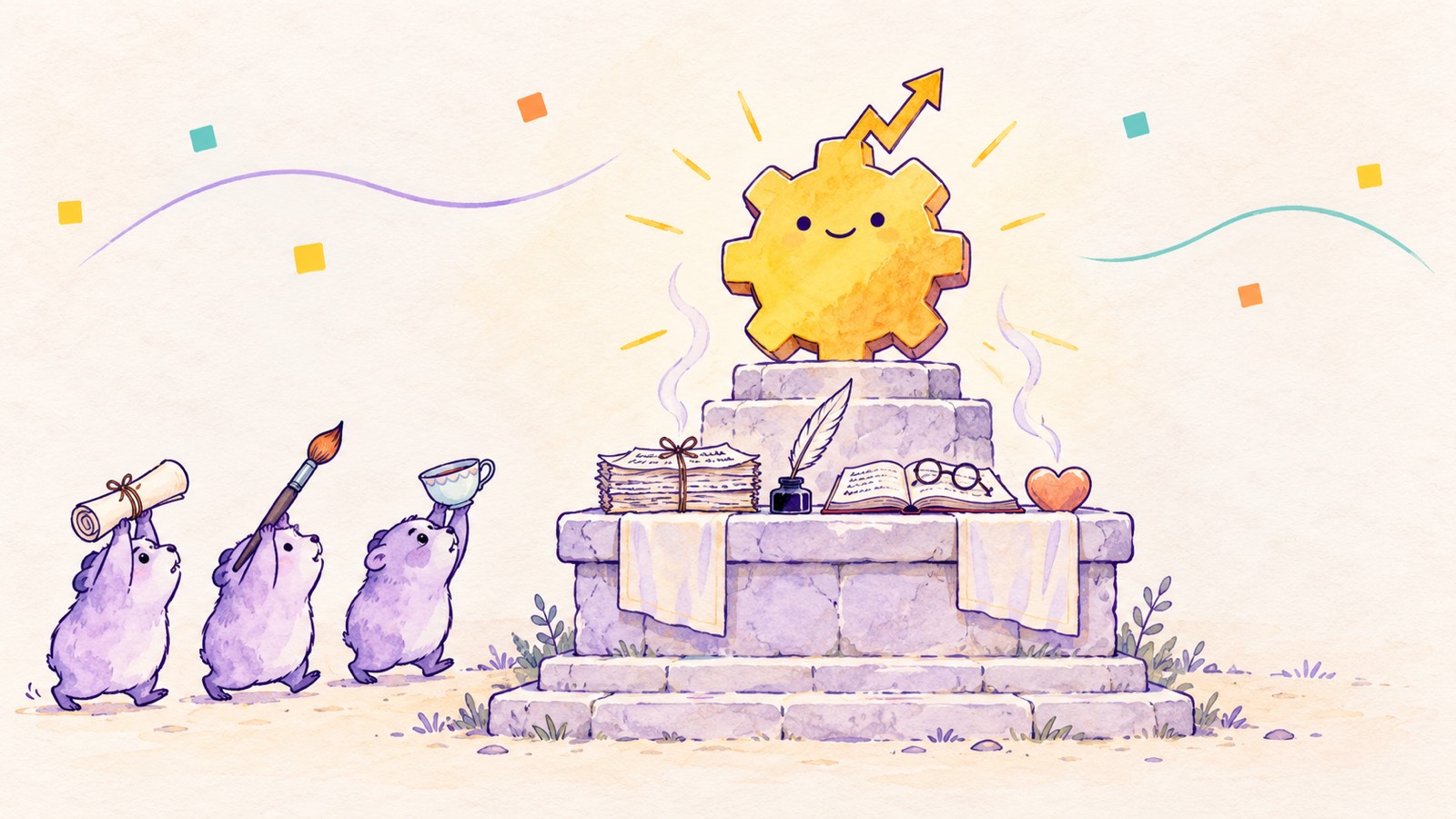
We marketers trek across the internet, listening to false prophets touting their snake oil to cure our every metric woe.
“SEO is dead,” the false prophets shout! Others rant about the impending doom coming to email and paid media. Most channels, at some point, have been marked as terminally ill or already deceased because an algorithm change creates a meaningful enough blip in its current efficacy.
“But fear not! Here is the only way,” they continue. Oh, convenient. We can be saved by the new software (or service or course) they’ve just released.
Marketers then bring up offerings and sacrifices to this new way. But instead of precious metals and jewels, flowers or delicious treats, we lay down brand experience, readability, craft, and care at the altar of the algorithm change.
Algorithms are, at their very simplest, proxies for a human-created quality bar. The algorithm asks very similar questions to what we ask, “is this engaging? Does it have depth? Is it relevant, credible, and comprehensive?”
Knowing what the algorithm believes connotes quality is important for short term growth. But chasing every micro-update and new hack is downright exhausting.
The future-proofed way forward is to come back to being people-obsessed, and yes, still algorithm-aware. People-obsessed means focusing on the experience of the end reader, giving them a unique answer based on proprietary data, deep subject matter expertise, or a unique point of view.
The pace of change is only increasing
At a conference earlier this year, I heard a CEO say that “with AI, changes in technology are happening quicker than ever. And the only thing I know for certain is that the pace of change will only increase.”
I’ve heard this many times before, but this time it poked at me for days, like a rock stuck in my shoe. This is a leader in technology. Telling us it’s only going to get worse.
Where does that leave us? Exhausted, overwhelmed, with no end in sight. And, dare I say, without any real leadership to tell us how to weather the ongoing storm.
In Google’s early days, they rolled out just a handful of major updates a year to how their search algorithm functioned. Now, there are thousands of minor shifts implemented annually alongside also more frequent, compounded "core updates". We’re talking about daily tweaks, 10 to 13 updates a day which adds up to more than 4k updates per year.
So, may I offer some calm leadership on how we can manage the ever increasing pace change: Let’s not keep our eyes fixed to the changelog nor follow the other lemmings blindly off the cliff. (Fun fact: Disney completely fabricated that lemmings follow each other into peril. But the analogy is still widely used.)
Instead, let’s focus on the things we know will not change.
Everything is changing but yet nothing has really changed
Search engines crawl and index the web, storing the content, code, and metadata in its own unfathomably large data base. Pages are scored via the algorithm flavor du jour, but looks at domain authority (backlinks), keywords, and technical aspects like site speed and user experience.
Answer engines break up the user’s questions into vectors and return a reply based on similar semantic proximity. That’s a mouthful, but ultimately it guesses the next right answer based on the probability that the answer is the next correct thing, rather than matching to a keyword/keywords.
I have great news for you. You don’t have to remember that.
Why do the algorithms behave in this way? If you are a millennial or older, try thinking back to how long it would take you to sort through the card catalog at the library, go find the right book, and flip to the page that had what you wanted to learn on it.
Indeed, it would take a human being impossibly long to parse through all of the information on the internet and find the answer that helps them the most. So, algorithms are a very useful stand-in for human judgment about quality and trust. Their long-term goal, whether it’s an SEO algorithm or an AEO algorithm or the LinkedIn algorithm or the next algorithm that nobody has invented yet, is to surface content people find worthwhile.
You can cheat the algorithm by tailoring your content to it instead of focusing on quality? Sure, but the algorithm always catches up. Brands that went all in on AI-generated blog articles saw an initial increase that came crashing down. Marketers flocked to Reddit to game mentions in answer engines only to watch citations from Reddit drop in August 2026 sharply.
Yes, I’ll agree with that CEO from the conference. The pace is only getting quicker. So, the one thing we can bet on is that these algorithms are smart and getting smarter (quicker than ever) at figuring out what’s good for real human beings - not purely the algorithm.
The reason channels die (and then reincarnate)
There’s a circle of life in marketing channels. New channels emerge. Early adopters find success. They grow, and people ask, “how did you do it?” They share their secret channel. More people try. More content, more conversations. The channel gets noisy. Efficacy wanes.
If it’s a digital channel, the channel creator might add in an algorithm to help surface the best messages to the right people. Marketers learn the algorithm and create content that gives it the best chance of reaching people. The algorithm changes to punish the algo-hackers and reward the best messages. The algo-hackers cry out, raise their hands in the air, and declare the channel is dead.
No channels truly ever die. I still get glossy magazines in the snail mail for DTC products all the time. But channels can get so noisy that we need the algorithms. They are filters to keep the channel usable. If we want to participate in the channel, we have to respect the algorithm.
Chasing algorithms is a fool’s errand. So don’t crush the bird.
Gerry Spence wrote this story in his 1996 book, How To Argue and Win Everytime:
Once there was a wise old man and a smart little boy. The boy was driven by a single desire – to expose the wise old man as a fool. The smart boy had a plan. He had captured a small and very fragile bird in the forest. With the bird cupped in his hands, the boy’s scheme was to approach the old man and ask him, “Old man, what do I have in my hands?” to which the wise old man would reply, “You have a bird, my son.”
Then the boy would ask, “Old man, is the bird alive or is it dead?” If the old man replied that the bird was dead, the smart boy would open his hands and allow the bird to fly off back into the forest. But if the old man replied that the bird was alive, the smart boy would crush the bird inside his cupped hands, and crush it, and crush it, until at last the bird dies. Then the boy would open his hands and say, “See, old man, the bird is dead!”
And so as the story goes, the smart boy went to the old man and he said, as planned, “Old man, what do I have in my hands?”
The old man replied, “You have a bird, my son.”
“Old man”, the boy than said, his voice dripping with disdain, “is the bird alive or is it dead?”
Whereupon the old man looked at the boy with his kindly old eyes and replied, “the answer is in your hands, my son.”
The bird is your relationship with your customers - current and future. If you grasp too tight (i.e. chasing the algos, not caring about the human experience, that bird is DOA.
If you open your hands (i.e. sticking your head in the sand and ignoring the algos and distribution of your content altogether), you lose the chance of building the relationship with your customers.
Meaningful brand and content work holds the bird at the right grip. That is, to understand distribution and algorithm changes, but never doing anything that would put the end human’s experience with your brand at risk.

Relationships will outlast the algorithms, because they always have
So my advice to marketers seeking a path out of the algorithm is this: May we turn our adoration to our customers, once again. The customers whose problems our products and services aim to solve. Their pain points, their language, their needs.
Tony Robbins highlights 6 core human needs:
Certainty,
Variety,
Significance,
Connection,
Growth, and
Contribution.
Those are the making of a future-proofed content strategy. The algorithms will be looking for content that does just that.