

Originally written by Jan-Erik Asplund in 2019. Revised in 2026.
BLUF is a military communications acronym that stands for "bottom line up front." It's a practice wherein you put the most important details first to enforce speed and clarity in reports and emails.
Don't tease or delay your main point because people are busy and their time is valuable. And make it clear. Life-or-death decisions could be made using your information (in the military at least).
Most content marketing doesn't BLUF. It spends too much time throat-clearing — setting context, explaining backstory — before getting to the point. And though content marketing isn't life or death, burying your main point costs readers time and cognitive effort.
We'll show you how to apply BLUF to blog posts, emails, Slack messages, and LinkedIn, plus how to find your BLUF when it's buried in your draft.
How to BLUF Your Own Writing
Your BLUF is usually hiding in your conclusion, buried under the thinking process you used to reach it. Pull it to the top using one of these three methods.
Answer the header’s question up top. If your H2 is "Why clear language matters," your first sentence should be a BLUF that answers that directly: "Clear language matters because your homepage is the first impression of your product."
Find your "so what." Every section has information. Your BLUF is the information that matters most to your reader. Ask yourself: If someone only read this one sentence, what would I want them to walk away knowing? That's your BLUF.
Check your conclusion. In first drafts, your main point often lives at the end — you write your way toward it. When you revise, pull that concluding sentence to the top. If your last paragraph starts with "In short," "The key takeaway is," or "What this means is," that sentence is likely your BLUF. It's just in the wrong place.
The goal isn't to be clever or comprehensive in your opening line. It's to give your reader the answer immediately so they can decide whether they need the supporting details.
Use the BLUF Method Everywhere
At Animalz, we use BLUF as a rule for writing content marketing, but we also use it in other communications — like Slack messages to co-workers or emails to customers.
Here are some BLUF examples for marketing and other digital touchpoints.
1) For Blog Posts: Delete Your Brain Dump
When you write your introduction, lead with your conclusion, not the path you took to reach it. Most writers draft blog posts the way they think through problems, starting with context, building evidence, and then finally landing on their main point. That's a great research process. It's a terrible reading experience.
When you revise, find where your thinking process still shows on the page. Delete the throat-clearing, the evidence-building setup, and the meandering introduction. Move your conclusion to the top. Only after the BLUF statement should you lead readers through your reasoning process.
One of the best examples of BLUF is Mitch Albom’s first line of The Five People You Meet in Heaven: "This is a story about a man named Eddie and it begins at the end, with Eddie dying in the sun."
The reader knows what they're getting in the first sentence.
2) For Email: Lead With Your Ask
In email, BLUF means stating your request or main point first, then adding context. Your recipient doesn't want to scan your email looking for what they need to do.
In this BLUF example, Joe leads with the most important information (finished edits) before explaining why it matters:
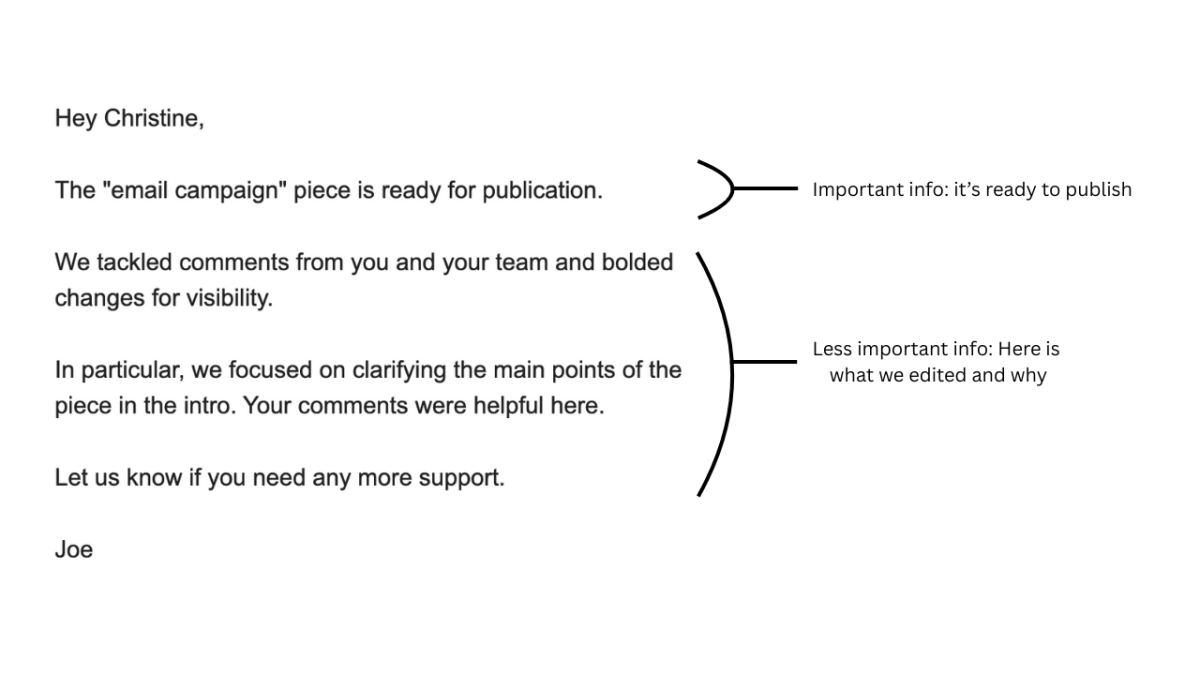
You can apply BLUF to emotional or urgent emails. Just lead with the one thing you want the reader to do after reading the email.
Here's an email we sent to a new Animalz customer after confusion around their first article. We needed to show urgency about fixing the problem and getting back on track.
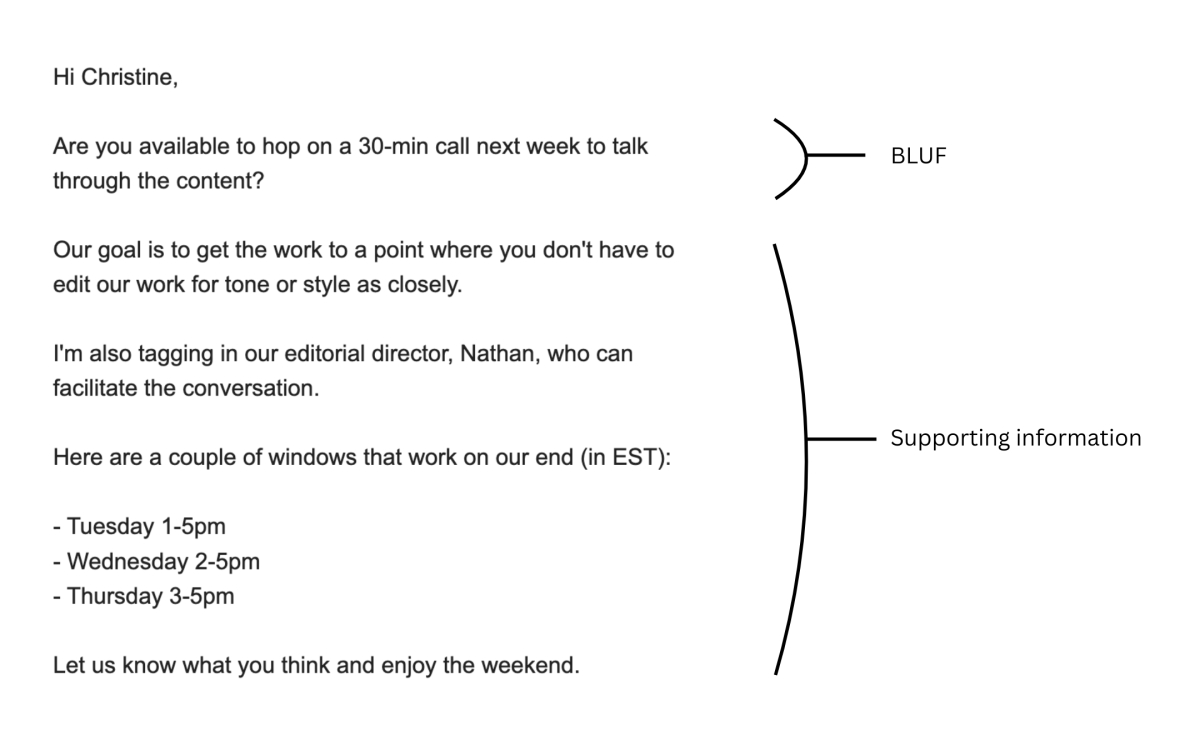
The opening line begins with what we want: a meeting. The next line explains why. We didn't ease into bad news or explain our reasoning first.
Visual hierarchy matters here. Information at the top of your email gets more attention. Use that real estate to make your single need clear.
Don't soft-pedal problems in an attempt to preserve the relationship. Over email, that creates more confusion.
3) For Slack: Message Once
Give the context your reader needs to act. Ask your question first, then add context. Include what you need and why you need it. This takes the burden of interpretation off the reader’s plate, reducing the amount of effort it takes to help you.
Here’s an example of what not to do:

Many people believe they should soft-open their questions by providing a disclaimer (“I have a question) but this disrupts your recipient's work twice. First, they have to read your message and respond. Then they have to wait for you to explain what you need before they can actually answer the question. Each exchange adds friction. Add up dozens of instances over the course of a day or week, plus time lost getting in and out of a flow state, and this kind of context-switching adds up to real time lost.
This next example offers a little more context, but it’s still too general. It needs more information for it to be an actionable request.

Instead, give as much context to the ask as you can, and do it in one message. Here’s the BLUF template you want to follow:

This example gives a clear what (“examples of thought leadership”) and a clear why (“putting together a proposal for Acme”) that, together, let the recipient infer more or less the asker’s exact need.
4) For LinkedIn Posts: Hook the Reader
LinkedIn is all about hooks, and BLUF statements provide a natural template to get them right. State your insight in the first line, then use the rest of the post to explain it. This gives readers a reason to click "See more" instead of scrolling past.
Without BLUF: I've been thinking a lot about content strategy lately. There are so many approaches out there, and it can be overwhelming to figure out which one works. After testing different methods over the past year, I've learned something important.
With BLUF: Content without a distribution strategy is just wishful thinking. Here's what I learned after a year of testing different approaches:
The first version buries the insight behind three sentences of setup. The second version hooks readers immediately with a strong claim, then promises supporting evidence.
When BLUF Statements Don’t Work
BLUF prioritizes clarity, but some situations call for a different approach. Skip BLUF when:
Delivering bad or sensitive news. Leading with "The project failed" reads as cold and abrupt. Provide brief context first to soften the delivery and show you understand the impact.
Cross-cultural communication requires indirectness. Some cultures view BLUF as aggressive or disrespectful, especially when addressing superiors. Research communication norms for your specific audience.
Complex topics require foundational context. If "We should migrate to a microservices architecture" means nothing to your reader without explanation, provide the technical background first so your recommendation makes sense.
Building narrative tension matters. Stories, case studies, fundraising appeals, and some marketing copy work better with gradual reveals than immediate answers.
When immediate clarity serves your goal, lead with your point — when it doesn't, provide context first.
Keep It Lean, Say What You Mean
BLUF takes effort. You have to know your point before you write, or go back and find it during revision. You have to resist the urge to build up to your conclusion or soften your message with a preamble. But that effort pays off for you and everyone who reads what you write.
When you lead with your main point, readers get what they need faster. Colleagues can prioritize your request without a second read. Blog readers stick around because you're not making them work for the payoff. And you write better because knowing your point up front forces clarity in everything that follows.
Start with your next email or Slack message. Ask yourself: What's the one thing I need this person to know? Put that first. Then build from there.