
Three years ago, we wrote that AI marked "the dawn of a new era in content marketing." That dawn is over. Everyone knows AI is here; the question is what to do with it. Or, as our Director of Content Engineering Tim Metz likes to put it: "Half your content can now be created by AI; the trouble is knowing which half."
We've spent years experimenting with AI in our own content operations. This guide compiles everything we've learned: frameworks for when (and when not) to use AI, strategies for adapting to AI Overviews eating your search traffic, and honest accounts of what we've done well and what we haven't.
In just the last few months we've published new articles covering quality maintenance, editorial standards, and workflow integration. The throughline: AI content strategy now demands what's called "content engineering," a combination of editorial craft and systems building. Neither skill alone cuts it anymore.
Originally published May 2023. Last updated: April 17, 2026.
AI Search & Visibility
AI search has changed how content gets discovered. These articles cover what's different, what's not, and where to focus your visibility efforts.
How AEO Differs From SEO
Three shifts distinguish AEO from traditional SEO, and each one has changed how we build content for our clients:
AI models surface self-contained answers: In our AEO audits, pages holding Google's #1 position regularly go uncited by ChatGPT and Perplexity because their content is built around click-through signals. AI models need structured, self-contained claims they can paraphrase or cite directly. Format and substance both determine whether you get surfaced.
AI models scan for extractable structure: AI models look for discrete, well-organized claims they can pull into a synthesized response. We've watched pages with strong keyword coverage get passed over because their insights sat buried in long narrative paragraphs. Pages with clear, scannable sections and specific evidence attached were the ones that got cited.
AI models cross-reference before citing: AEO authority depends on whether your claims appear across multiple credible sources and whether you cite evidence inline. In our full SEO vs. AEO comparison, we break down how this cross-referencing works in practice.
AEO layers these requirements on top of your existing SEO playbook. The pages that win in both channels ground every claim in evidence, break insights into scannable structure, and make it easy for AI models to extract and attribute.
As you adapt your strategy for the new search era, you'll be dealing with AEO (a.k.a. GEO, a.k.a. LLMO).
Is it the new SEO? Is it just SEO with a different name? Both takes are out there.
Sure, there's plenty of overlap: AEO builds on the foundation of SEO, and it relies on the same infrastructure, quality standards, and trust signals.
But AI systems process content differently. These models don't rank pages like search engines. They read, extract, and verify information across sources. We get into how this translates into AEO-specific requirements for content creation, management, and distribution.
Read SEO vs. AEO: A Field Guide for B2B SaaS Content Marketers
How to Build Visibility in AI Search
Visibility in AI search isn't one thing. It's three layers that build on each other, and most teams only work the first one.

We've built a framework called the AI Visibility Pyramid that maps the three layers required for visibility in AI search. Each layer builds on the last, and you work all three in monthly cycles: one SEO improvement, one citation-worthy asset, one credibility play.
Read AI Visibility Pyramid: How to Improve Your Presence in AI Search
What to Do About Google's AI Overviews Eating Your Search Traffic
This is the top question for most content teams right now. Google's AI Overviews (AIO) are quietly killing click-through rates, down by 15% to 35% in some studies. Odds are, your Search Console is telling the same story.
It doesn't mean search is dead, it's just different. You need to shift priorities: Put conversion efficiency over raw traffic numbers, cover every BOFU keyword your competitors are ignoring, and build content that turns fewer visitors into more pipeline.
Read AI Overviews Are Eating Your Search Traffic
Why We Gave Up on Reddit for AEO
Reddit's AEO moment lasted about eight months. In September 2025, Reddit citations in ChatGPT crashed 80 percent. Even before the crash, Reddit accounted for just 1.8 percent of ChatGPT citations and 2.2 percent of Google AI Overviews. The upside was always capped; the downside arrived without warning.
One parameter change at Google (removing num=100) caused the collapse. Neither Google nor OpenAI owes you stability, and building strategy on third-party platforms means accepting that risk.
The better alternative: invest in domains you control. On your own site, you own the narrative, the accuracy, and the shelf life. Reddit can be part of your distribution mix, but it shouldn't be the foundation of your AEO strategy.
Read Why We Gave Up On Reddit For AEO
AI Content Quality
Speed without quality is just faster failure. These pieces cover editing checklists, context engineering, and the organizational roles that keep AI content publishable.
How to Maintain Quality in AI-Generated Content
AI can produce a passable first draft in minutes. But the hours you save disappear fast if you spend them fixing hallucinated statistics, scrubbing generic phrasing, and rewriting sections that technically answer the question but say nothing memorable.
Update your editing checklist for AI
Quality control for AI content requires a different checklist than traditional editing. You're hunting for the specific failure modes that language models produce.
Fact-check every claim and statistic against a primary source. AI models hallucinate confidently. A plausible-sounding "study from Stanford" may not exist. Verify before publishing.
Verify brand voice consistency. Does this sound like your company wrote it, or like a language model's idea of professional writing? Read a paragraph from your best-performing human-written piece, then read the AI draft. The gap should be obvious.
Hunt for AI-tell phrases. Flag and replace: "delve," "furthermore," "it's important to note," "in today's digital landscape," "at its core." These phrases signal AI authorship to readers who've seen enough AI content to recognize the patterns.
Confirm original perspective exists. If you removed your brand name, would this read like anyone's article? Generic information presented generically doesn't build authority.
Validate all links and sources are current. AI training data lags behind the present. Links break. Companies pivot. A "recent study" might be five years old.
Check for unsupported superlatives and vague claims. "The best approach," "a significant improvement," "many experts agree" all need specifics or deletion.
Read the piece aloud. AI prose sounds smooth but flat. When you read it aloud, the monotony becomes obvious. Vary the rhythm.
Agent-based tools like Claude Code can now automate several of these checks: source verification, link freshness, and voice consistency scoring. The checklist still holds; the difference is that AI can help run it.
Your team needs both editorial judgment and engineering skills
Quality AI content requires two skill sets that rarely exist in the same person: editorial judgment and engineering capability.
We learned this the hard way at Animalz. When we started building AI into our content operations, we put our editorial director in charge. Editorial instincts help you recognize when a draft misses the mark. They don't help you debug why the workflow keeps producing the same error, or how to restructure your data pipeline when a model update breaks your prompts.
The systems work, building workflows, managing versions, fixing edge cases, routing outputs, required a different mindset. Now we pair editorial judgment with engineering capability. The editorial eye catches quality problems; the systems brain prevents them from recurring.
Match quality standards to content type
Quality isn't one bar. Different content types require different standards.
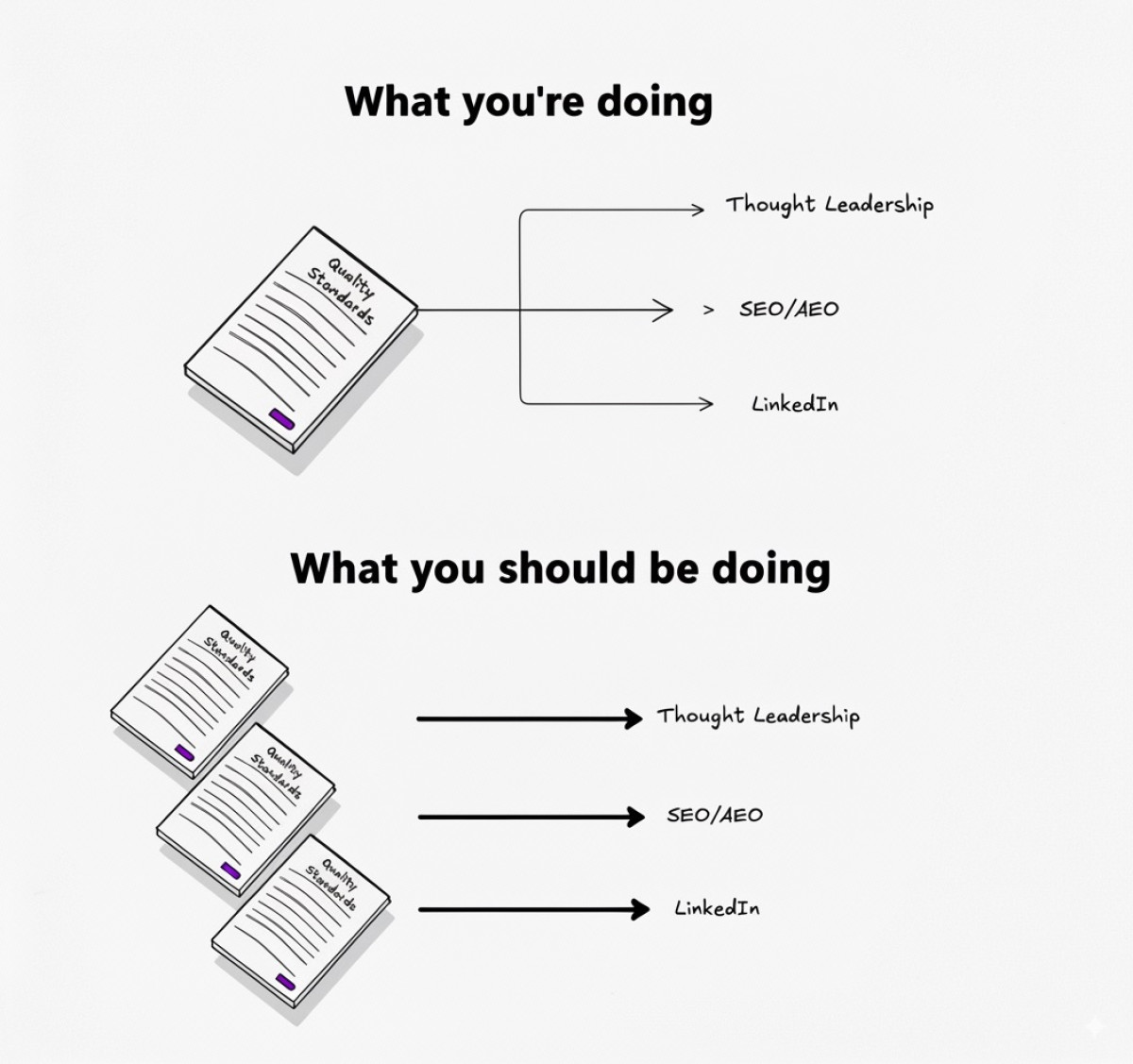
Tier 1: AEO/SEO content. The first audience is an AI model or search engine. The quality bar: on-brand, factually accurate, answers the query directly. These pieces don't need journalistic excellence; they need strategic targeting and consistent voice. You can produce higher volumes here because the burden of quality is lower. A solid Tier 1 piece gets the job done without pretending to be thought leadership.
Tier 2: Thought leadership. Original insight, expert sourcing, zero detectable AI patterns. Every claim grounded in experience, data, or named examples. A reader should remember the argument, not just the information. Tier 2 pieces build the reputation that makes Tier 1 pieces discoverable. Skip this tier and you become another copycat content producer.
Tier 3: High-stakes assets. Whitepapers, original research reports, flagship case studies. Original data collection, professional design, rigorous multi-round review involving subject-matter experts. These pieces justify major budget decisions and build enterprise credibility. AI can accelerate research synthesis and early drafts, but the final product requires heavy human investment.
The framework: identify the "burden of quality" each piece carries, then resource accordingly.
Read The Burden of Quality: When High Standards Drag You Down
Designate a quality accountability owner
Designate one person accountable for AI output quality across all tiers. At Animalz, our editorial director holds this role. Someone needs to own the question: "Would we publish this if a human had written it?"
Without single-point accountability, quality standards drift. Each editor makes judgment calls. Acceptable variance in human-written content becomes unacceptable inconsistency when AI scales production.
How Context Engineering Improves AI Content Quality
Better prompts won't fix bad inputs. The real breakthrough in AI-assisted content comes from context engineering: building the right information environment before you ever type a prompt.

The term captures something most teams miss entirely. You can spend hours refining your prompt language, but if the AI lacks brand intelligence, audience models, competitive intel, and quality examples, you'll get generic output every time.
Read Your Prompts Are Fine: Context Engineering Is Your Next AI Problem
AI Strategy and Frameworks
Before you build, decide what to build. These articles cover the strategic frameworks, model selection, and mindset shifts that separate productive AI use from expensive experimentation.
Why You Should Not Outsource Your Thinking to AI
AI promises to cure writer's block. Just press the button and boom: instant first draft.
Don't do it.
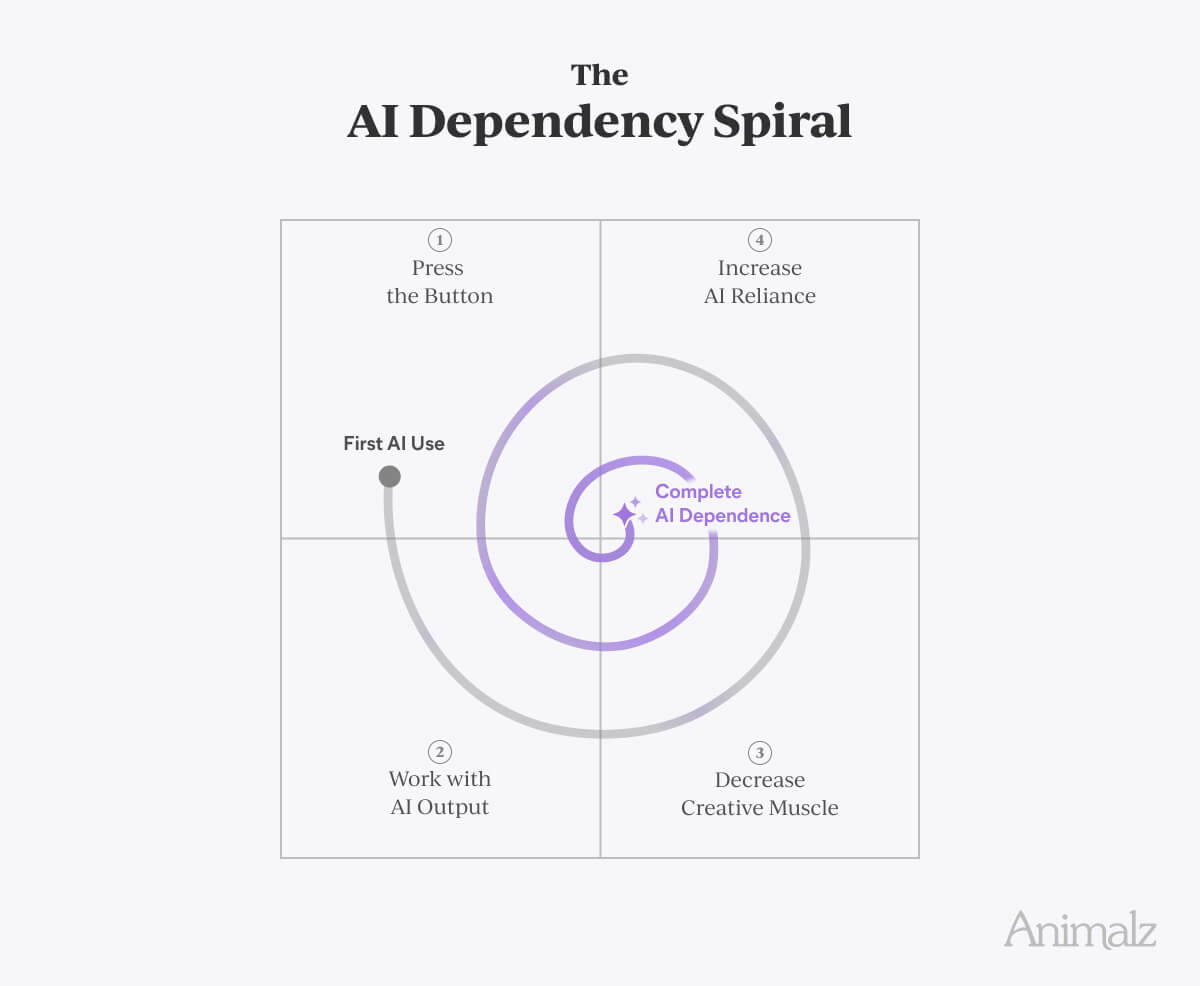
Letting AI fill your blank page is like sending a robot to the gym for you. Your mental muscles atrophy. You anchor to mediocre ideas. You skip the serendipity where your best thinking happens.
Wrestle with the blank page yourself first before bringing AI on board.
Read Stay Strong: Never Let AI Fill Your Blank Page
How Content Leaders Use AI
AI has taken root in content workflows, but to make it work without losing quality, you need boundaries and best practices.
We asked five content leaders from Preply, Freed, Semrush, Planable, and KNIME to share their approach to AI workflows, where they use it, and where they don't.
The through-line across all our findings is that you need a strategy for using AI. Consider this your blueprint for building one.
Read 5 Content Leaders Share 7 AI Insights for Your Team
How to Match AI Models to Your To-Do List
You wouldn't hire a single person to be your developer, designer, writer, and analyst. Similarly, using just one AI model is like having a team of one.
Different models give you drastically different results. If you default to one AI model for every task, the TIP Method offers a smarter way. Break down your work into tasks, match them to the level of intelligence you need, and choose based on personality. It will help you find the best fit for each task.
Read The TIP Method: Choose the Right AI Model for Every Task
Finding Your Optimal Human-to-AI Ratio
Use AI as a brainstorming partner and fine-tune the outputs? Feed it your POV and let it handle the rest? Or go against the flow and become a writing purist?
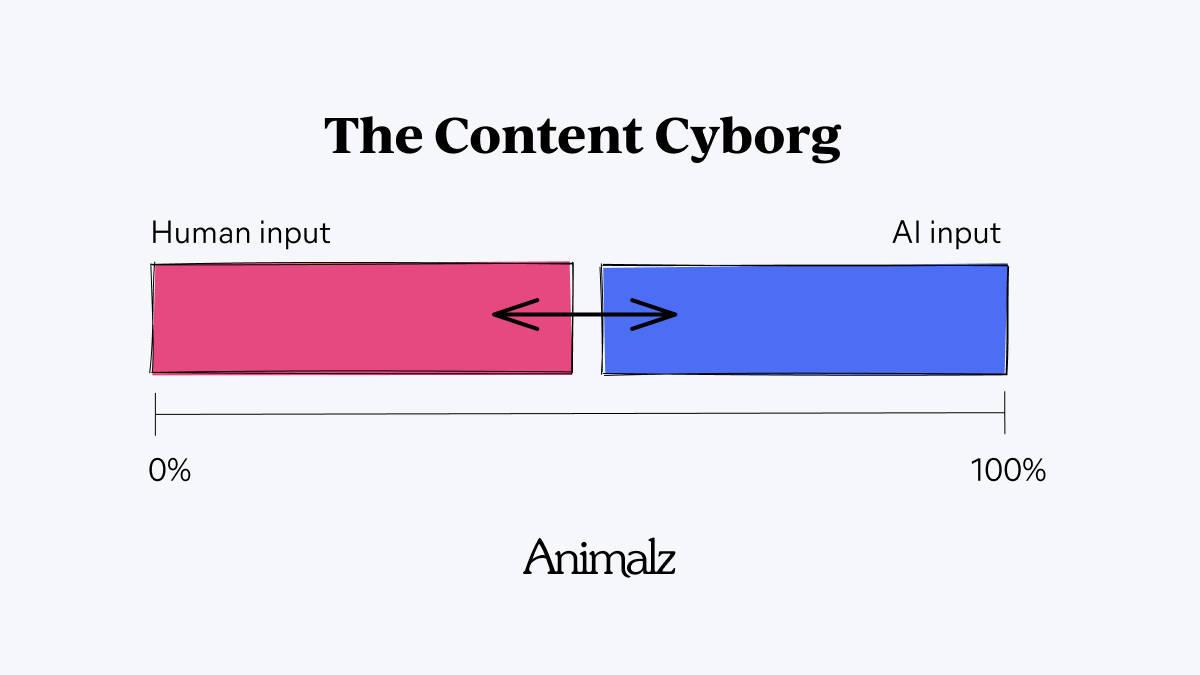
We tried it all, and our answer is none of these. Blending human creativity with AI power isn't one-size-fits-all. We share how to find the right balance.
Read The Content Cyborg: How to Use AI Writing Tools in Content Marketing
Is ChatGPT Pro Worth $200 a Month?
Two hundred dollars for an AI subscription. What would possibly make it worth as much?
We've been testing ChatGPT Pro since launch, and here's what swayed us: o3's deep research rivals a junior analyst, it gives you the ability to process 150-page documents without losing the thread, and using it to vibecode actually works.
Of course, it's not all good, and we get into the cons, too.
Read The $200 AI Question: Should You Upgrade to ChatGPT Pro?
What We Learned From Three Years of AI Experiments
We're a quality-obsessed content agency, so yeah, you're probably wondering how we square that with AI.
Let's walk you through our entire AI journey, year by year, experiment by experiment.
We tried an efficiency play that bombed because clients still expected our usual standards. We tried a free-for-all approach that created dozens of inconsistent workflows. Now we're doing something that's working, and we put someone obsessed with editorial quality (not coding) in charge of it all.
Read Our AI Journey: Lessons from Failed Experiments and Where We Are Now
AI Workflows & Systems
Workflows are the starting point; systems are the destination. From building your first AI workflow to scaling a compounding content operation, these articles cover the engineering side of content engineering.
What It Takes to Build AI Content Workflows
When getting on board with AI, most teams don't realize they're building a mini-product that needs QA, documentation, and someone to maintain it.
AI helps increase output, but it doesn't necessarily reduce work. It saves you time on writing, but then you spend it building workflows, reviewing robotic drafts, and managing expectations.
You need complete workflows (not just ChatGPT in a tab), skilled editors who can tell if content is actually worth publishing, and strategic planning to decide what's worth creating in the first place.
Read AI Content Works (But Only If You Do the Work)
The AI Onion: Three Layers of AI Content Systems
Most teams that try AI content never get past the first layer: workflows. Beyond that lie data infrastructure and feedback loops. Each layer compounds the value of the layers below it. A competitor can copy your model; they can't copy the system knowledge you've accumulated by running it for six months.
Read The AI Onion: Why Most AI Content Programs Fail
Don't Stop at Workflows: Build a Compounding Content System
The teams pulling ahead treat their AI operation like a product: version-controlled, continuously improved, and measured by output quality over time. The full framework explains why some teams compound their advantage while others plateau after the first workflow.
Read Don't Stop at Workflows: Build a Compounding Content System
How to Use Claude Code for Content Marketing
Claude Code works in plain English. You don't need an engineering background to use it. The interface accepts natural language, and the agent handles the technical translation.
The advantages over chat-based AI are exponential. Claude Code writes directly to files, uses your local documents as context, runs parallel agents for complex tasks, and maintains persistent memory through a CLAUDE.md file.

Use cases for marketers include competitive analysis, custom tools (Chrome extensions, style calibrators), content audits, and data dashboards. The distance between "I wish this existed" and "I built it this afternoon" has vanished. You don't need to wait for a developer or submit a ticket. You can prototype and ship the same day.
Read Claude Code for Content Marketers
How We Built an SEO Tool With AI
Our own Tim Metz built an SEO forecasting tool in Claude's interface in under an hour. It looked great. It didn't work.
He had to move to Cursor to build something fully functional, and it took weeks. But it's still miraculous to build a tool as a non-developer, and the journey was insightful.
Tim covers the full process. He explains why you need at least three different AI tools to pull it off, the challenges you'll face as a non-coder, and how to avoid headaches along the way.
Read Code Is Now Content: How We Built Our SEO Calculator With AI
Reflections
What we predicted, what surprised us, and what we're still figuring out.
The Six Prophecies That Explain Today's Content Marketing
Ryan Law wrote predictions for AI in July 2022, four months before ChatGPT launched. He laid out how AI would reshape content marketing from the work we do to the roles we take.
Every single prediction came true. The article perfectly explains what's happening in content marketing right now.
Read 6 Predictions About AI in Content Marketing
AI Addict Tells All
Some days, our team swears by AI and forgets how to write a simple email without its assistance. Other days, we make vows to use it responsibly.
Tim Metz captures that struggle, tracing his own spiral into dependence and how he clawed his way back (or did he?).
Read Confessions of an AI Addict
For the Love of Content

Mariana Fernandes wrote something we keep coming back to: a meditation on what content marketing lost somewhere between SEO optimization and AI automation, and whether AI is attacking the discipline or just exposing its existing hollowness. It's the kind of piece that makes you stop and reconsider why you got into this work in the first place.
Conversations With People Building With AI
We spent a season of the Animalz podcast with leaders who are building with AI, not just talking about it.
Some highlights? Nathan Baschez (Lex) on reimagining writing with AI. Kyle Coleman (then Copy.ai, now at ClickUp) on giving marketers their weekends back. Alex Halliday (AirOps) on what he learned from conversations with Sam Altman.
Listen to Introducing the AI & Content Season: Real Talk, No Hype
The Morning's Still Young
This guide will look different in six months. New models will ship, new workflows will replace the ones we just built, and at least one thing we're confident about today will turn out to be wrong.
A guide about AI content strategy should change as fast as the field it covers. We'll keep adding experiments, retiring what stops working, and being honest about the gap between what we recommend and what we've figured out.
If you've read this far and want to start building, the Claude Code guide is the fastest on-ramp. If you want the philosophical foundation first, start with For the Love of Content. And if you want to hear practitioners talk through the messy reality, the podcast season is for you.
Originally published May 2023. Last updated: April 17, 2026.